Resilience Spotlight: Pilot Program Predictions
What Happens When You Stress Test a Digital Twin?
When we invited our first cohort into the Mangrove Whitespace Pilot, we didn’t just ask for their pitch decks. We asked for their predictions.
Specifically, we asked: “Where will your business break when you double in size? And what do you think the Mangrove pilot will actually find?”
We did this because operational resilience isn’t just about systems; it’s about mindset. Does a founder know what they’ve signed up for? Or do they think resilience is just a fancy word for better software?
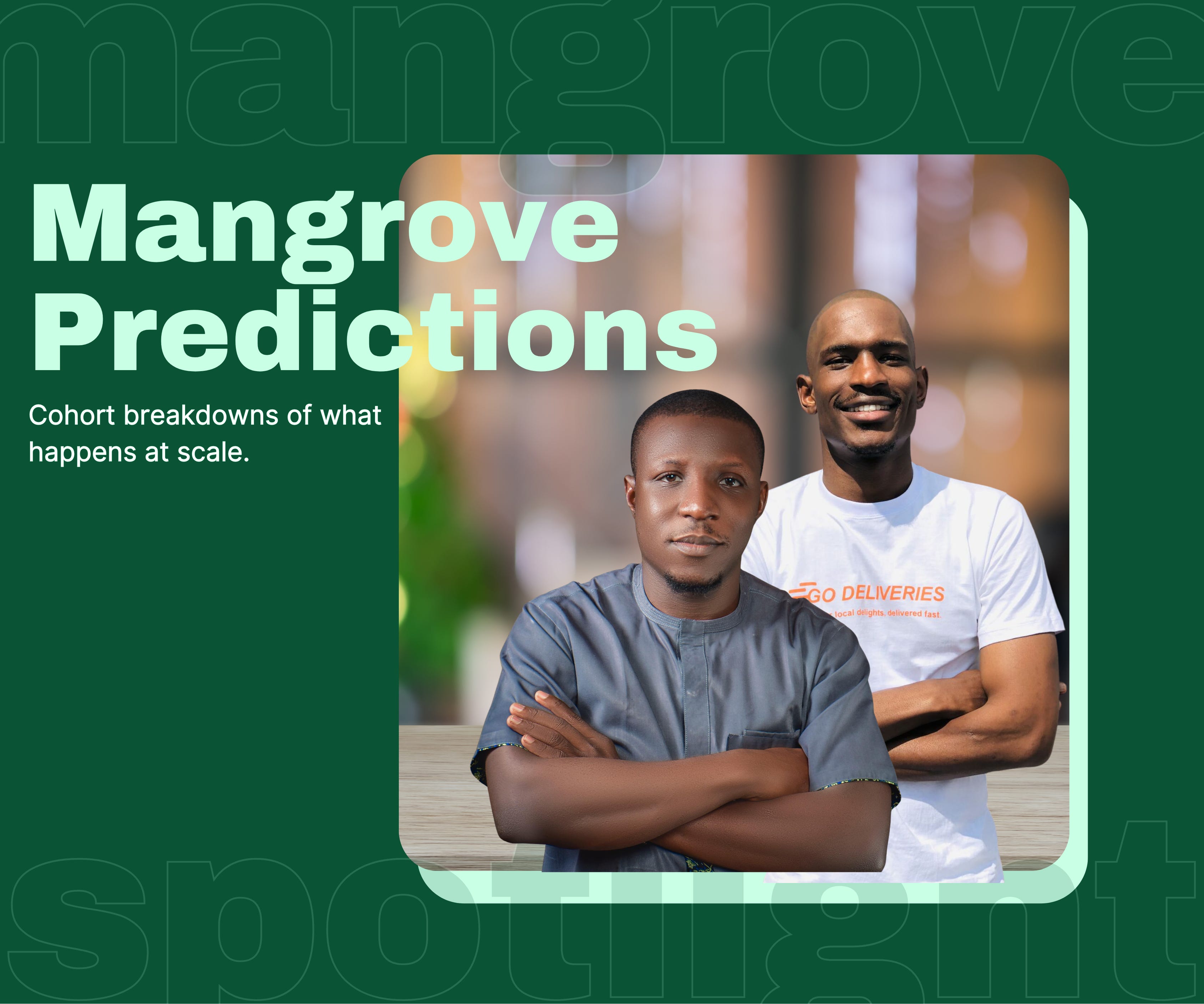
This week, we’re breaking down the predictions of two very different ventures: Timart and Go Deliveries.
Timart: The Visibility Challenge
The Venture: SME Retail Operating System (Nigeria)
Muhammad is building a fortress for neighborhood merchants. But he knows that when the silent leaks stop, the next challenge is holding the merchant’s hand through the growth.
The Founder’s Hurdle: Muhammad’s biggest fear isn’t just a server crash, it’s the human element of growth. If demand doubles, can the internal processes keep up with the merchant on the ground?
“Our biggest operational risk is scaling onboarding and support... as you keep going, if demand increases, retention will be a very big challenge.”
The Prediction: Muhammad isn’t just looking for better support, he’s looking for clarity. He wants to map out every internal activity to ensure value stays consistent as they expand.
“I think I need more clarity on how to actually map out activity, especially as we are scaling... to consistently deliver value.”
The Mangrove Reality Check: Muhammad is focused on retention, but the silent killer of a SaaS platform for SMEs isn’t just churn, it’s the support to revenue ratio.
As Timart scales to the next 50,000 merchants, if the clarity Muhammad is looking for isn’t built into the product’s self service logic, his overhead for manual onboarding and dispute resolution will scale faster than his profit.
We are building a digital twin of Timart’s Service Delivery Chain. We aren’t just mapping how the app works; we are mapping how much human effort it takes to keep one merchant active. If it takes a 10 person support team to manage 1,000 merchants today, how do we make sure it doesn’t take a 500 person team to manage 50,000 tomorrow? That is the resilience gap.
Go Deliveries: The Velocity Challenge
The Venture: Social-Commerce & Food Delivery (Kenya)
Kalvin and Vincent are running a high speed logistics machine in Nairobi. In his world, a 40 minute promise is the law, but that law gets harder to enforce as the map grows.
The Founder’s Hurdle: For Go Deliveries, scaling is a math problem. Doubling demand means an exponential need for a reliable, massive rider network to keep the promise alive.
“If demand doubled right now, we would need a lot more riders... 270 riders covering the whole of Nairobi seems unrealistic. We would need about 2,000.”
The Prediction: The goal for the pilot is simple, find the future problems while Go Deliveries is still in the present. Looking for the redundancies and bottlenecks that are currently invisible but will become fatal at scale.
The Mangrove Reality Check: Kalvin is thinking like a logistics pro. But resilience in delivery isn’t just about the route, it’s about the vendor social ecosystem. If a meal goes viral and 100 people order at once, does the vendor’s kitchen have the operational logic to survive the surge? We predict the pilot will show that the true resilience whitespace is vendor readiness. If the kitchen breaks, the social platform dies.
Want to Join the Whitespace Pilot?
If you’re a founder building in complexity, logistics, fintech, health, climate, supply chain, mobility and you know your business is one small break away from chaos…
this is exactly what the Mangrove Whitespace Pilot Program is for.